Research · architectural theory
aktionsraum
Waste is cool: what counts as waste is a matter of perspective. A master's project on reuse in architecture, from twelve demands for material-conscious building to a built test field made of salvaged materials.
- Type
- One-semester master's project, Chair of Architectural Theory
- Theme
- reuse in architecture
- Location
- RWTH Aachen, Hoogcruts (NL)
- Semester
- Summer 2023
- Supervisor
- Axel Sowa
Reuse, recycling and urban mining shift attention from the supposedly worthless to what already exists: used materials and components are understood not as waste but as resources with architectural potential.
From this perspective, our team developed demands for material-conscious building. A short documentary with Rotor DC in Brussels added a view of existing practice to the theory. Finally, a hands-on workshop translated the findings into a built intervention and put them to a critical test.
Headlines, statistics and social media make it ever clearer how important it is to build with fewer resources. In practice, however, there is little sign of a shift away from purely commercial interests. The project asks how the built environment can be used sustainably over the long term and explores, in theory and practice, how reuse and recycling can work in architecture.
Dirt is an idea bound to context and to culture.
from waste to value
Inspired by Kevin Lynch's posthumously published book Wasting Away, the essay examines how waste is perceived in architecture. Lynch uses the term broadly, for anything considered worthless or unused, from rubbish to surplus resources and vacant buildings. What counts as waste depends on culture and context. Questioning these conventions reveals the value of using resources consciously.
waste as a social problem
Economic growth made the throwaway society's mountains of rubbish grow. Around 1970 the USA produced some 300 million tonnes of waste a year, mostly dumped in simple landfills that took up land and released toxins. Lynch saw not only a problem but also potential. His question “Waste for whom?” points to recovering raw materials through targeted recycling and so saving natural resources.
waste in construction
In 2020, more than 90% of mineral demolition waste in Germany was recycled, replacing 13% of the primary raw materials needed. Much of it, however, is crushed using a lot of energy and used only for low-grade purposes such as road sub-bases. Planned deconstruction and urban mining go further: materials and components are removed from buildings before they are demolished.
That is exactly what Rotor DC in Brussels does. The company dismantles components such as stone cladding, tiles, sanitary fittings, doors, bricks and floorboards, refurbishes them and sells them on. In the interview, Christophe Escalé explains how this works in practice.
architecture with waste
Extending the idea to whole components or buildings produces resource-saving architecture from reconfigured parts. In 2022 the Austrian practice Gaupenraub+/- worked with students of a building trades school to dismantle a disused field barn and rebuild it 80 km away, replacing damaged parts visibly. Superuse Studios from the Netherlands reverse the design process: it starts with a “harvest map” of the materials available nearby, and only then does the design begin.
waste as a carrier of meaning
Even in antiquity, old buildings served as stores of material, and reused components carried meaning: Charlemagne had columns and mosaics brought from Rome and Ravenna to Aachen. Today, too, seemingly worthless material becomes a landmark, as in the Watts Towers in Los Angeles or the entrance halls of the 2016 Architecture Biennale, built from the remains of the previous art biennale.
Lynch asks whether materials might also be chosen for their qualities in old age. The Japanese tradition of wabi-sabi shows how ageing, imperfection and repair can be valued. At the same time, a city needs a certain amount of waste: gaps left open make room for people to take over spaces and for future development.
12 thoughts on circular architecture
Think further, again, differently!
We commit to a future in which we produce less waste and reuse and recycle as many used materials as possible.
Go round in circles!
We call for raw materials already in our environment, our cities and everyday products to be kept in the materials cycle. In particular, building products and components should be reused.

Long live building materials!
We call for the longest possible life span for old and new buildings alike. The design should already consider what can happen to buildings and materials once they reach the end of their life.

Make waste your #1
We learn to value what is old and used again. We see the city as a rich store of raw materials, and we accept imperfect, repairable materials and waste as full-fledged resources.
For a perfectly imperfect world
We value the history of a building component and celebrate the aesthetics of imperfection, transience, ageing and patina. We celebrate the beauty of the imperfect.

Repair the world the way you like it
We learn and practise how to work with this resource: we repair to extend life spans, and reuse or recycle components to build something that works. We draw on proven methods and also create new things with forward-looking ideas.

Wise from the build
We document the process and approach in detail. The knowledge gained is presented clearly and made easily available to everyone.
Professionals at work!
New training programmes are needed to educate experts in handling specific building materials and components. Specialists are needed to guarantee proper workmanship.
New rules = old rules
Standards, codes and warranties must not stand in the way of building consciously with recycled materials.
From you to me & from me to you
We call for knowledge on recycled materials to be passed on to local actors. Through training, building with waste finds its way into real projects.

The price is right
We call for building with used materials to become comparable in price to building with new ones. Only then will the idea catch on economically.

Buy local! In building too
We call for local sourcing and reuse to take priority, to protect the environment and resources.
Playing loads the video from YouTube. Watch on YouTube
hands on Hoogcruts
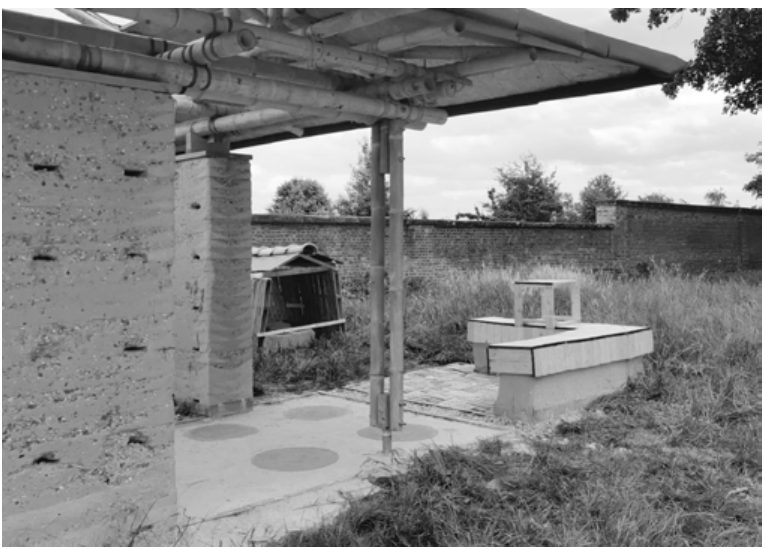
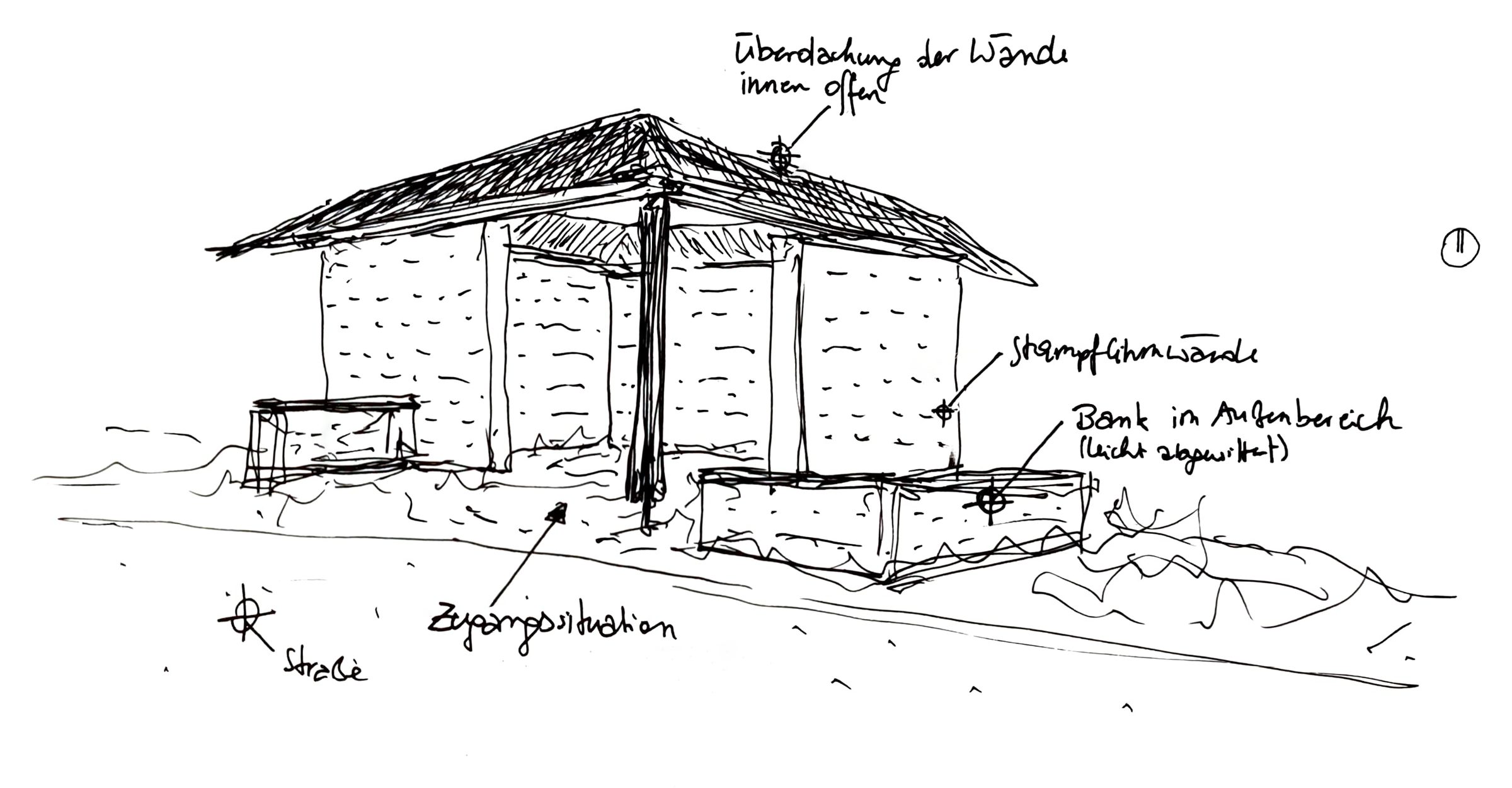
On the former monastery grounds of Hoogcruts (NL), which the Chair of Architectural Theory has used for regionally sustainable building experiments for several years, earlier semesters had built a pavilion with rammed-earth walls and a bamboo roof.
Since the pavilion had no floor yet, it gave us the chance to try out a selection of used materials and laying techniques and to study how they last and age.

material from the surroundings
The principle of our intervention, to reuse materials that had already served a purpose, first led us to online marketplaces and around the region in search of used paving. We made a point of staying within a few kilometres of Aachen to keep transport distances short.

opus hoogcrutium
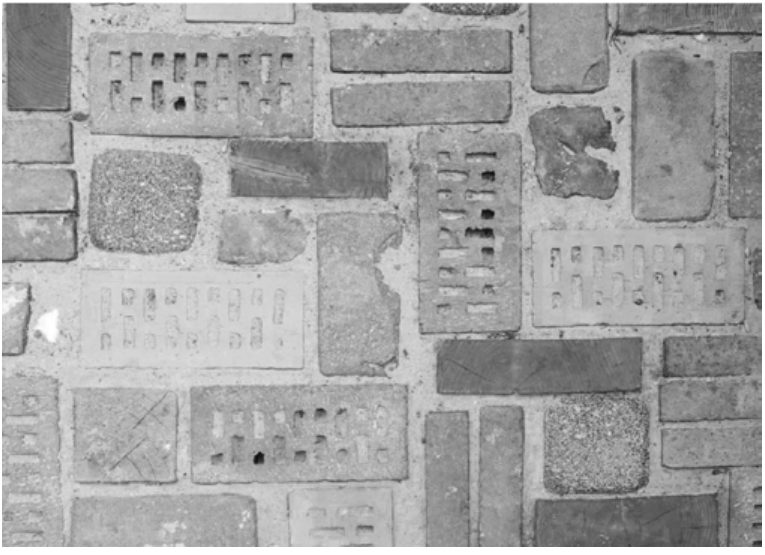
During the several-day workshop we laid the collected materials, natural stone, clay bricks, clinker and end-grain parquet, in an open, mixed bond in a gravel bed. This bond, which we named the Opus Hoogcrutium, brings out the character of each material while showing how they work together as a whole.
It became especially clear how important it is to respond dynamically during the design process. Divided into separate areas, the test field is tuned functionally and aesthetically to the conditions on site. Working with real materials thus became a critical test of the demands we had formulated.